


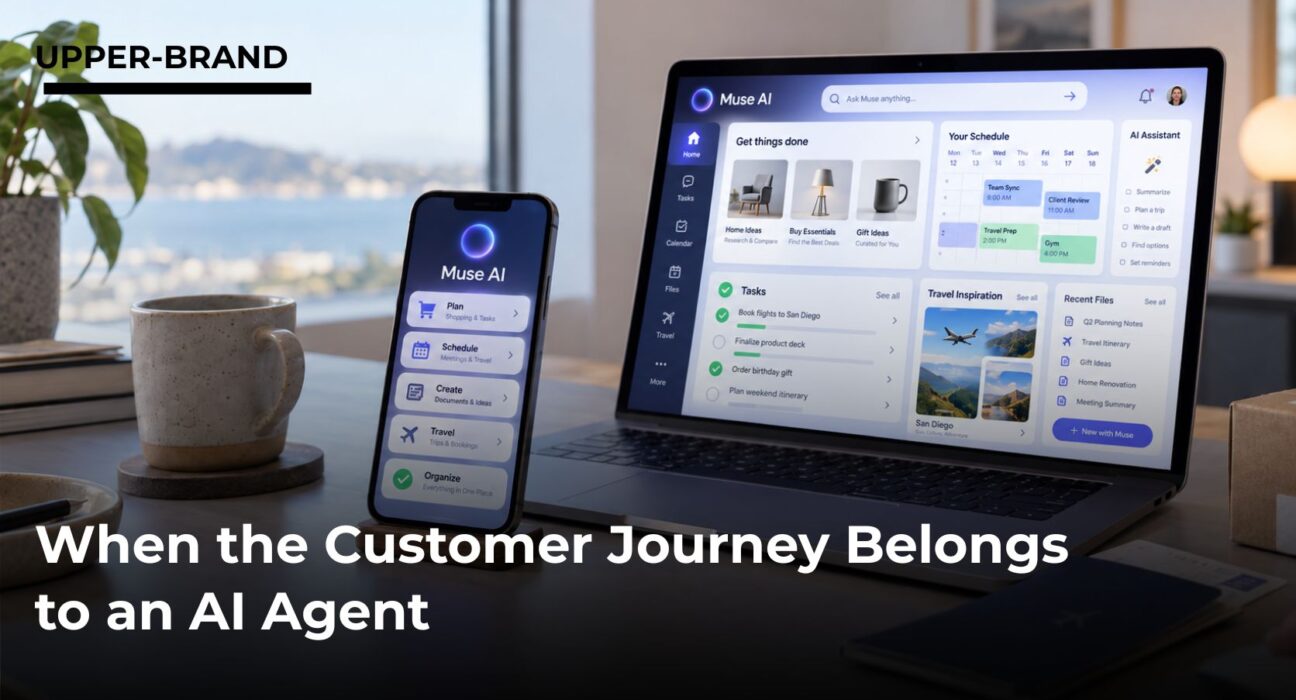
Agentic commerce is creating a new layer between premium brands and the people they serve
For years, sophisticated brands have invested heavily in controlling the customer journey.
Every detail could be designed: the first impression, the product page, the packaging, the service language, the checkout experience and the aftercare that followed.
Agentic AI introduces a new possibility.
The customer may still choose the brand, but an AI agent may perform much of the journey on the customer’s behalf.
Meta’s newly launched Muse is an early example. Meta says the personal AI agent can browse websites, fill forms, send messages, book travel, negotiate and make purchases. Reuters reported that Muse passed 2.5 million downloads within roughly two weeks of its September 8 U.S. launch.
The more revealing development is how commerce platforms are responding.
Amazon blocked Muse from shopping on Amazon.com, saying Meta had not obtained authorization for the agent’s access. Shopify has moved in the opposite direction by adding Meta as an AI channel within its Agentic Storefronts infrastructure.
Those decisions reveal a new design question for brands: how much of the customer experience should be allowed to happen inside an interface the brand does not control?
The interface is becoming a layer of brand strategy
Luxury, premium and image-driven brands have traditionally treated the interface as part of the product.
A carefully photographed item, a considered product description, the pacing of a digital storefront and the tone of customer support all contribute to perceived value.
An AI agent can compress that experience.
A customer may no longer browse five product pages. They may ask an agent to find the best option that meets a set of criteria, compare delivery dates and complete the purchase.
The brand may still earn the sale, but many of the moments designed to build preference can disappear.
That does not make agentic commerce inherently damaging to brand equity.
It does mean that brands need to distinguish between the parts of the customer journey that can be delegated without loss and the parts that create long-term emotional value.
Convenience and distinction are not the same thing.
Discovery may increasingly depend on structured clarity
The rise of AI agents could also change what it means to be discoverable.
Human shoppers respond to storytelling, visual hierarchy and atmosphere.
Agents need structured information.
They need accurate titles, prices, availability, dimensions, options, delivery conditions and return policies.
Shopify’s documentation says participating AI channels can use product titles, descriptions, images, prices and availability. This suggests a future in which product-data quality becomes inseparable from brand visibility.
A beautifully designed product page can still fail if the underlying information is incomplete or inconsistent.
For premium brands, that creates an unexpected operational priority.
Catalogue discipline is no longer merely administrative. It becomes part of brand stewardship because inaccurate data can cause the brand to be misunderstood or excluded by the systems increasingly mediating discovery.
Brands should decide where the customer relationship must remain direct
Shopify’s approach is instructive because it allows merchants to participate in AI channels while retaining choices.
Eligible merchants can expose products through Agentic Storefronts. In some configurations, they can also disable direct checkout and send the customer back to the merchant’s own online store.
That creates a useful strategic spectrum.
At one end, a brand can let an AI channel handle discovery and transaction because friction reduction is the priority.
At the other, a brand may use the agent only for discovery while preserving checkout, consultation or service inside its own environment.
The appropriate choice depends on where brand value is created.
For a commodity purchase, an invisible transaction may be acceptable.
For a considered fashion purchase, a bespoke service or a product associated with craftsmanship, the final interaction may be an important part of the experience.
The point is not to resist automation.
It is to automate deliberately.
Customer ownership becomes more important as intermediaries multiply
Brands have already learned this lesson from marketplaces, social commerce and delivery platforms.
A new distribution channel can create reach while weakening direct customer knowledge.
Agentic commerce may repeat that tension.
A sale generated through an AI assistant is valuable.
But the brand should still ask what it receives beyond the transaction.
Does the merchant know who the customer is?
Can the business provide aftercare directly?
Can it understand why the customer chose the product?
Can it build a relationship after the first purchase?
Can the customer return without the agent standing in the middle again?
These questions matter because premium brands depend on memory, recognition and repeat preference, not simply unit volume.
An intermediary that improves conversion while obscuring the customer relationship may have a hidden long-term cost.
## Agentic commerce can blur attribution and experience measurement
Traditional customer-experience measurement assumes that a customer interacts with touchpoints directly.
AI agents complicate that model.
One customer instruction can generate multiple automated visits. The agent may compare products, revisit inventory, complete checkout elsewhere and never show the brand’s primary site to the customer.
That means familiar indicators can lose some meaning.
A rise in page traffic may reflect machines rather than people.
A low engagement time may not indicate weak content if an agent extracted the required information efficiently.
A sale may be attributed to a channel that the customer never consciously experienced.
Brands will need new forms of measurement that separate human attention from agent activity and distinguish transaction efficiency from relationship quality.
Trust becomes part of the luxury of convenience
Muse also highlights the trust required for truly personal AI.
The agent becomes more useful as people connect services and grant authority.
Meta says Muse operates inside a dedicated cloud virtual machine, separates credentials from the main agent and uses a Sentinel system to evaluate sensitive actions. Users can establish different permission levels, and Meta says the agent asks for approval before consequential steps such as purchases.
These are thoughtful safeguards.
Meta also acknowledges that the system can make mistakes and that prompt injection remains an unresolved industry problem.
On September 22, The Verge reported that Meta patched a vulnerability in the Muse Mac application after security researcher Patrick Wardle demonstrated a way to redirect part of the agent’s processing. Meta said the exploit required malicious software already running locally.
For brands, this matters even when they are not building the agent themselves.
Customers will judge the experience as a whole.
If an AI-mediated transaction fails, produces the wrong order or creates a privacy concern, the merchant may still share reputational consequences even if the technical fault sits elsewhere.
Premium brands should therefore evaluate AI channels not only on reach and conversion, but on the quality and trustworthiness of the complete experience.
The human element may not disappear as quickly as expected
Reuters reported that Meta is internally testing a human-concierge capability for some Muse phone calls. Human contractors may step in when the agent cannot complete a call automatically.
Meta says the test is internal and intended to improve privacy and safety before wider use.
The experiment is revealing because it shows that the future customer journey may not be purely automated.
It may be hybrid.
A request could begin with software, move through a human intermediary and return to automation before the customer ever speaks directly with the brand.
That makes transparency increasingly important.
Brands may need to know who is representing the customer at each stage and what authority that representative actually has.
Restraint will become a competitive skill
There will be strong pressure to participate in every new AI channel as soon as it offers access to customers.
That instinct is understandable.
But premium brand management has always required selective participation.
Not every platform, partnership or distribution method strengthens the brand simply because it adds reach.
Agentic commerce should be treated with the same discipline.
Brands should evaluate where AI improves service, where it weakens experience and where a direct relationship remains essential.
The most sophisticated strategy may not be maximum automation.
It may be coherent automation.
Canadian brands should watch the commerce layer
Meta currently describes Muse as a U.S. rollout, so Canadian brands should be cautious about treating U.S. adoption figures as evidence of broad domestic use.
The infrastructure is nevertheless relevant.
Shopify’s agentic-commerce programs already include merchant contexts that involve Canada, and the broader movement toward AI-mediated discovery and transactions is not dependent on Muse alone.
Canadian brands can prepare by improving product-data quality, defining agent permissions and deciding which parts of the experience should remain inside their own digital environment.
The future customer journey may belong to more than one interface
The era of a single, brand-controlled journey is already fading.
Customers move through search engines, social platforms, marketplaces, applications and physical environments before making a decision.
AI agents add another layer, but a potentially more powerful one because they can act.
Amazon’s response to Muse emphasizes control.
Shopify’s response emphasizes structured participation.
Meta’s strategy emphasizes delegation.
Brands now need their own answer.
The enduring advantage will not come from resisting the new interface or surrendering to it completely.
It will come from knowing which parts of the customer relationship are transactional, which are strategic and which are too important to outsource.
Sources: Meta, Reuters, Fortune, Shopify and The Verge. Publication date: September 23, 2026.