

The most memorable brand experiences often begin with a simple ambition: create a moment people will not forget.
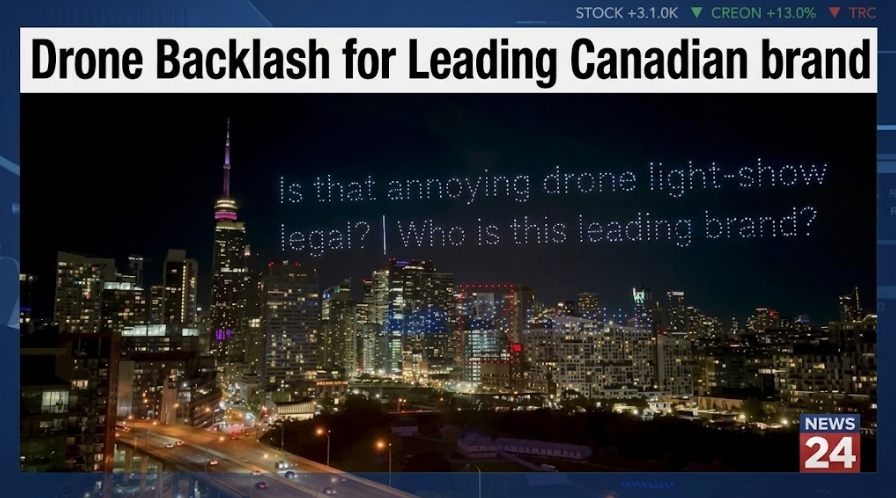
PC Health achieved that in Toronto on September 10, when more than 1,000 drones formed health-related questions over the waterfront near Fort York before revealing a QR code connected to PC Chat, its new AI-powered health information service.
The execution was visually ambitious. It translated a product idea into the physical environment and transformed late-night health questions into a literal presence in the night sky.
It was also divisive.
CBC reported criticism from residents who described the display as intrusive and dystopian. The campaign prompted a broader conversation about whether commercial messages should occupy shared visual environments that people cannot easily avoid.
For brand leaders, the lesson is not that spectacle should disappear from the creative toolkit. The lesson is that spectacle is most effective when it is disciplined by context.
Brand Experience Is More Than Visibility
Experiential marketing is often valued because it escapes the limits of conventional media.
A beautifully produced physical activation can create memory in ways that a digital ad rarely can. It can become part of the environment, generate photographs and video, and continue to travel through social platforms long after the event ends.
Drone displays are particularly powerful because they combine technology, scale and choreography. They can feel closer to public performance than to advertising.
That is also where the design responsibility becomes greater.
A brand experience does not exist only in the eyes of the intended customer. It also exists in the experience of everyone nearby.
When an activation appears above a neighbourhood or public site, the audience includes people who have not chosen to participate. That difference should influence creative restraint.
The Toronto Campaign Was Authorized
The PC Health activation was not an unauthorized intervention.
The City of Toronto said it had permitted a drone light-show activation above Fort York National Historic Site. Loblaw Companies Limited stated that the required permits had been obtained. Transport Canada confirmed to CBC that it issued a Special Flight Operations Certificate for the campaign.
Those approvals are important. They establish that the execution was planned within a formal regulatory process.
But they do not resolve the design question.
Brand stewardship requires more than meeting the minimum threshold for permission. It requires understanding the emotional relationship between the brand, the audience and the setting.
The night sky carries a different meaning from a retail screen or a social feed. It feels shared, open and non-commercial. Introducing a commercial message into that environment can therefore produce an emotional response that is disproportionate to the actual duration of the activation.
That emotional response becomes part of the brand experience.
The Product Promise Should Guide the Medium
PC Chat is positioned around clarity, health information and trust.
Loblaw says the service is based on Canadian clinical guidelines and informed by more than 1,000 Canadian clinical sources. PC Health says conversations are stored in Canada and that users can connect health information for more personalized answers. The service can also connect people to pharmacists and other care options when appropriate.
These features create a brand promise built around reassurance and responsible guidance.
The drone campaign expressed a different set of qualities: scale, surprise, novelty and unavoidable visibility.
There is nothing inherently wrong with those qualities. The design challenge is whether they reinforce the desired perception of the product.
The strongest experiential branding usually feels inevitable after it is seen. The location, form, pacing and tone appear so aligned with the brand that the experience could not belong to anyone else.
When the medium becomes the main story, that alignment can weaken.
In Toronto, some of the public discussion moved away from the health service and toward whether the sky should be used for advertising. That shift should interest any brand leader planning a high-impact activation.
Premium Branding Often Depends on Knowing When to Stop
Sophisticated branding is frequently associated with beautiful typography, materials, photography and environments.
Its deeper quality is restraint.
Restraint determines what is omitted, how long an experience lasts, how loudly a message is expressed and how much space is left for the audience.
That principle matters even more when technology makes excess easy.
A drone vendor may be able to put 1,000 lights into the sky. A projection system may be able to cover an entire facade. A digital display may be able to animate continuously. A geolocation platform may be able to target customers repeatedly.
Capability is not a creative brief.
The fact that a medium can dominate attention does not mean a brand should use its maximum intensity.
For image-conscious companies, especially those operating in luxury, design, hospitality, wellness or professional services, overstatement can reduce perceived confidence. The most effective experience may be the one that leaves room for the audience rather than consuming the entire field of attention.
Place Is Part of the Brand System
Brands often treat location as logistics.
It should be treated as meaning.
Fort York is a historic site within a dense urban environment. The Toronto waterfront includes residential, transportation and public spaces. A late-night aerial activation in that context will be perceived differently from the same choreography at a ticketed festival or stadium event.
The place tells people how to interpret the experience.
This is why environmental context should be incorporated early in creative development, not added during permitting.
Questions should include: What does this location mean to the people who use it? What time of day changes the emotional tone? Will the campaign feel like an addition to the setting or an occupation of it? Does the experience offer value to people who never become customers?
These are brand-design questions, not merely operational ones.
The Opportunity Is Still Significant
Drone shows and other forms of experiential technology will continue to attract brands because they can create something digital marketing often struggles to deliver: a shared moment.
That value should not be dismissed.
In a fragmented media environment, shared moments can create cultural relevance. They can make a launch feel tangible. They can generate images that travel naturally through editorial and social channels.
The Toronto activation demonstrated that potential. It was widely discussed because it was visually unusual and impossible to reduce to another standard ad placement.
The goal for brand leaders is not to abandon that ambition.
It is to refine it.
A public-facing spectacle should feel proportionate to the place, appropriate to the product and considerate of the people who encounter it unexpectedly.
Restraint Can Be a Competitive Advantage
As technology makes dramatic brand experiences easier to produce, drama itself will become less distinctive.
Judgment will become more valuable.
The brands that stand out will not necessarily be the ones that make the largest display or create the loudest interruption. They will be the ones that understand when scale creates meaning and when scale merely creates noise.
PC Health’s Toronto campaign offers a useful reminder that visibility and affinity are different outcomes.
A memorable campaign can create both, but only when the experience is designed around the audience as carefully as it is designed around the brand.
The most enduring brand experiences do not simply occupy space.
They earn their place within it.