


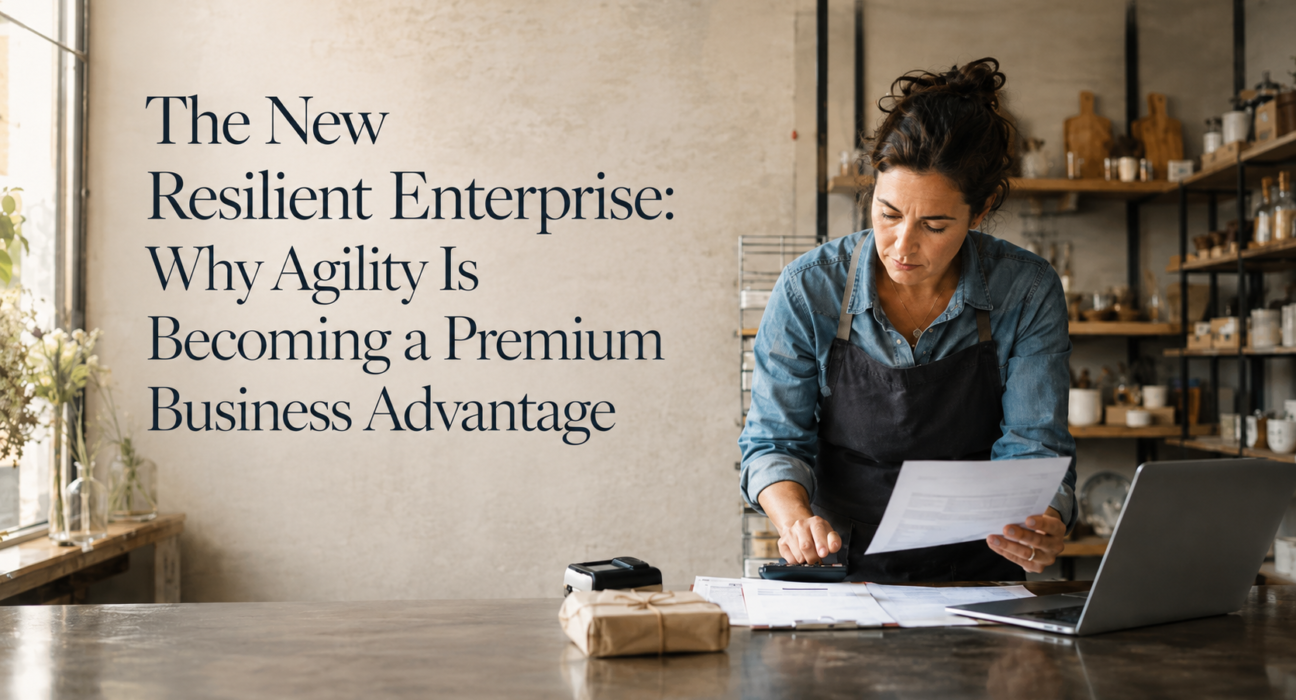
Resilience has traditionally been discussed as a defensive business quality, something a company needs when conditions deteriorate.
In 2026, that interpretation is becoming too narrow.
For small and medium-sized brands across Canada and the United States, agility is increasingly a source of competitive distinction. The ability to adjust pricing with confidence, protect customer experience, change suppliers without compromising quality and preserve investment capacity is becoming part of how a premium business is designed.
The environment is forcing the issue.
Costs remain elevated across many categories. Trade policy is creating new uncertainty. Customers are more attentive to value. Yet business optimism remains surprisingly durable.
The opportunity is not to pretend that these pressures do not exist. It is to build a brand that can respond to them without appearing reactive, inconsistent or diminished.
Cost Pressure Tests Brand Discipline
The Federal Reserve Banks’ 2026 Report on Employer Firms found that rising costs of goods, services and wages were the most common financial challenge among U.S. small employer firms surveyed in late 2025. More than four in ten also reported increased tariff-related costs, and 77% reported one or both challenges.
For any brand, higher costs create an immediate temptation: preserve demand by absorbing the increase, or preserve margin by raising the price.
Premium businesses have a third responsibility.
They need to preserve meaning.
A price change that feels arbitrary can weaken trust. A cost reduction that becomes visible in materials, packaging, service or experience can damage the brand more deeply than a transparent increase would have.
This is why cost management and brand management can no longer be treated as separate conversations.
The strongest businesses will decide where to protect quality, where to redesign the offer and where to ask the customer to pay more because the value remains credible.
Pricing Power Is Earned Before It Is Needed
Federal Reserve data show that 76% of firms with higher foreign-input prices passed at least some of the increase to customers, while 60% absorbed at least some themselves.
The overlap is revealing.
Companies are sharing the burden between the P&L and the customer.
For a premium brand, the ability to pass through a reasonable increase depends on the strength of the relationship that existed before the cost shock. Clear positioning, distinctive service, product quality and customer confidence create room to reprice without immediately becoming interchangeable with a lower-cost competitor.
That room should not be mistaken for unlimited pricing power.
SoFi’s 2026 microbusiness survey found that 26% of owners said customers had become more price sensitive. Even loyal customers are comparing value more carefully.
The strategic question is therefore not, “Can we raise prices?”
It is, “Can we explain and support the value represented by the new price?”
That can lead to better decisions: improved packaging, more useful service tiers, clearer guarantees, better communication or the removal of features customers do not value.
Agility should refine the offer, not simply make it more expensive.
Canadian Brands Face a Distinct Trade Challenge
For Canadian businesses, cross-border exposure is especially important.
Statistics Canada’s latest business survey found that 32.2% of businesses expect U.S. tariffs on imports from Canada to negatively affect them over the next 12 months. In manufacturing, the expected negative impact rises to 49.7%.
The issue extends beyond exporters.
A Canadian design studio may source American materials. A retailer may purchase through a distributor whose costs depend on U.S. suppliers. A hospitality brand may face transportation and food costs affected by broader trade and energy conditions.
These pressures can gradually change the economics of a customer experience.
That makes supplier strategy a brand issue.
A replacement input may be cheaper but visually inferior. A new manufacturer may meet cost targets but not quality standards. A faster logistics option may protect delivery promises but reduce margin.
The refined response is not to optimize cost in isolation. It is to evaluate the full brand consequence.
Supplier Optionality Can Protect Quality
One of the more striking findings in the Federal Reserve report is how few firms changed suppliers after foreign-input prices rose. Only 13% shifted to domestic suppliers and 8% to different foreign suppliers.
That is a reminder that supplier flexibility is difficult to create under pressure.
Premium businesses should build optionality before they need it.
That may mean qualifying a second manufacturer, maintaining more than one material specification, developing local alternatives for critical inputs or designing products with enough flexibility to accommodate substitutions without altering the customer experience.
A resilient brand does not need a large supplier list. It needs credible choices.
The objective is to prevent a single cost shock from forcing a visibly inferior decision.
Optimism Is Still a Brand Asset, but It Needs Discipline
Business confidence remains remarkably constructive.
Statistics Canada found 72.6% of businesses were very or somewhat optimistic about the next 12 months. CFIB’s long-term small-business optimism index stood at 57.6 in August.
In the United States, NFIB’s Small Business Optimism Index rose to 99.8 in July, above its long-term average.
The numbers do not suggest carefree expansion. NFIB’s Uncertainty Index also rose sharply, and Canadian short-term small-business confidence is weaker than the longer-term view.
That difference is valuable.
It suggests many owners still believe in the future of their businesses while becoming more selective about the next investment.
For a premium brand, this is a healthier posture than reflexive caution.
A company that cuts marketing, service and product development at the first sign of pressure may protect cash temporarily but weaken future relevance. A company that expands without discipline may create the opposite problem.
Agility means knowing what must continue.
Protect the customer touchpoints that define the brand.
Protect the people who create the experience.
Protect the product attributes customers genuinely recognize.
Then challenge everything else.
Resilience Can Improve the Customer Experience
The best cost response is not always invisible.
Sometimes pressure forces a business to simplify.
A brand may remove a confusing service tier, reduce unnecessary packaging, consolidate a product line or use technology to shorten response times. Those changes can lower cost and improve the experience at the same time.
This is where resilience becomes a premium advantage.
SoFi’s microbusiness survey found that owners were not only changing prices. They were changing hours, expenses, marketing, services and customer mix.
That kind of flexibility can be strategic when it is guided by a clear understanding of the brand promise.
The danger is random reaction.
Every cost cut should answer a simple question: does this make the customer experience weaker, neutral or stronger?
If the answer is weaker, the saving may be more expensive than it appears.
The Role of Contracts and Commercial Design
The Bank of Canada’s latest Business Outlook Survey highlights another underappreciated dimension of agility.
Firms reported that mechanisms such as fuel surcharges and cost escalators gave them more ability to pass higher expenses through to customers. Other businesses were constrained by fixed contracts, competition or weak demand.
Commercial terms are part of resilience.
A sophisticated business should not wait for a cost shock to discover that a long-term agreement has no flexibility. Contract design, review cycles, deposit policies, minimum commitments and adjustment clauses can all affect the ability to protect quality without sacrificing margin.
This is particularly relevant for service firms, wholesalers, manufacturers and business-to-business brands where pricing may be locked for months.
A Premium Advantage Built on Control
Agility is sometimes mistaken for speed.
The stronger definition is controlled responsiveness.
It is the ability to change without losing identity.
That means understanding margin by product and customer. It means maintaining supplier alternatives. It means preserving cash for decisions that protect long-term value. It means treating pricing as a reflection of positioning, not just a reaction to cost.
Entrepreneurial confidence remains alive in 2026. U.S. business applications continue at high levels, while Canadian and U.S. surveys show owners maintaining constructive long-term views.
The brands best positioned to benefit from that confidence will not be the ones that ignore uncertainty.
They will be the ones designed to move through it gracefully.
In a market where cost pressure is becoming common, operational agility can become uncommon. That difference is where a resilient enterprise begins to look like a premium one.
Source transparency
Data and source references used in this article include the Federal Reserve Banks’ 2026 Report on Employer Firms, Statistics Canada’s Canadian Survey on Business Conditions for the third quarter of 2026 and its second-quarter small-business analysis, the U.S. Census Bureau’s July 2026 Business Formation Statistics, NFIB’s July 2026 Small Business Economic Trends results, CFIB’s August 2026 Business Barometer, the Bank of Canada’s second-quarter 2026 Business Outlook Survey, and SoFi’s March 2026 microbusiness survey.